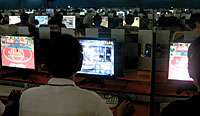
Online game protests in China - A public lecture
The SFU School of Communication Presents:
"Beyond the “Great Firewall”: Negotiating Online In-Game Protests in China"
A public talk by Prof. Dean Chan - University of Wollongong, Australia
SFU Harbour Centre (515 West Hastings St., Vancouver)
Thursday February 2, 2012
7-9pm, Room HC 1520 *previously 2270
This event is free, and open to the public – all welcome !
ABSTRACT:
Online in-game protests are part of a burgeoning global cartography of activism and mass mobilization unfolding across virtual worlds. Such protests nonetheless deserve to be negotiated on their own specific terms if only because these situational inter-plays of political, social, and gaming practices provide a unique means to gain insight into the socio-cultural contexts and imperatives that variously provoke, animate, and enable these acts. This presentation focuses on in-game protests that have recently taken place in the People’s Republic of China.
Dr. Dean Chan is Senior Lecturer in Digital Communication at the School of Social Sciences, Media and Communication, University of Wollongong, Australia. His research centers on digital communication (especially gaming and social media) and visual culture (especially contemporary art and comics) in the Asia-Pacific region, focusing on East Asian contexts and diasporic Asian issues. Recent publications include the co-edited book Gaming Cultures and Place in Asia-Pacific (Routledge, 2009) and the co-edited special issue of Amerasia Journal (2010) entitled “Asian Australia and Asian America: Making Transnational Connections”. He is Founding Convenor of the International Network for Diasporic Asian Art Research (INDAAR) [http://www.indaar.asianaustralianstudies.org] and Associate Editor of Studies in Comics (Intellect Journals UK).
This event is sponsored by: SFU School of Communication, SFU CounterCulutre series, Institute for the Humanities, SFU English, UBC English.
Labels: China, online games, protest
posted by Florence Chee, PhD at 10:16 AM
0 comments