Tuesday, March 02, 2010

Back from Mexican 'ciber'space
The eagle has landed, amidst the afterglow of the Vancouver 2010 Winter Olympics.
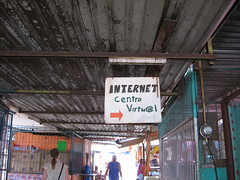
I was doing my own triple axles down in Mexico looking for Internet Cafes with people who spend time in virtual worlds though, spanning several cities including sprawling Guadalajara, colonial Guanajuato, coastal San Patricio/Barra de Navidad, and quaint Colima. The Internet cafes are often referred to as "cibers."
The Mexican context presented its own particularities and challenges, because unlike Korea, digital gaming is viewed as a juvenile and/or geeky antisocial activity. Still grappling with accessibility issues (one of the lowest in the OECD), the Internet cafe facilities are caught at various 'moments in time,' that may or may not enable participation in virtual worlds. Another factor is the battle between console and PC gaming. Furthermore, in the ample public spaces I previously blogged about, there are numerous 'free' and 'offline' activities.
That's just a glimpse of how I spent my "Olympic Break." Suffice it to say, "This will be in my report!"

Labels: , , , ,

Monday, February 15, 2010

In Guadalajara

It's been a busy while preparing for this latest stint of fieldwork...

I'm currently at the Universidad de Guadalajara, CUCEA, where I'll be affiliated as a researcher for the next two weeks. With my compadres from the institute here, along with the concurrent SFU field school, I'll be looking at the online gaming culture/Internet cafe scene in the Mexican context through my involvement in the VERUS project.

First impressions, I'm in awe of the sheer amount of collective public space and its influence on the communication ecologies here.

With amazing timing, I witnessed a large scale act of civil disobedience--a rally in support of same-sex marriage (right now it's only legal in Mexico City). We were in the state quarter, with government affiliates who were against the rally ringing cathedral bells (shown above) to drown out the protest. It felt very powerful to be in the middle of it all.

The tip of the iceberg, for now.

Labels: , , , ,

Monday, January 25, 2010

So, gaming does NOT cause rickets.

As I ventured in the last blog entry, the story on games causing rickets was just plain "lazy journalism." The quote straight from the scientist who helped to write the report is now on record saying, "We do not say that gaming causes rickets."

How many times have we seen this happen? Come on, people. Be responsible--don't be moral panicking game haters. That's just "dodgy journalism."

Labels: , , , ,

Wednesday, September 23, 2009

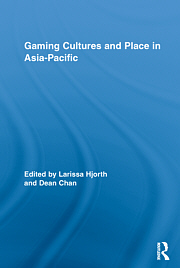
New book out: Gaming Cultures and Place in Asia-Pacific

Just got my copy of a new book from Routledge, "Gaming Cultures and Place in Asia-Pacific" edited by Larissa Hjorth and Dean Chan. Dal Yong Jin and I wrote the first chapter in Part I titled, "The Politics of Online Gaming," where we explored the geo-political, economic, cultural and social dimensions of Korea's creative industries in the form of online gaming.

You will also find contributions from...
Sam Hinton, Peichi Chung, Benjamin Wai-Ming Ng, Jun-Sok Huhh, Melanie Swalwell, Dean Chan, David Surman, Christian McCrea, Theodor G. Wyeld / Brett Leavy / Patrick Crogan, Ingrid Richardson, Holin Lin / Chuen-Tsai Sun, Larissa Hjorth / Bora Na / Jun-Sok Huhh

Description of the book:
This collection explores the relationship between digital gaming and its cultural context by focusing on the burgeoning Asia-Pacific region. Encompassing key locations for global gaming production and consumption such as Japan, China, and South Korea, as well as increasingly significant sites including Australia and Singapore, the region provides a wealth of divergent examples of the role of gaming as a socio-cultural phenomenon. Drawing from micro ethnographic studies of specific games and gaming locales to macro political economy analyses of techno-nationalisms and trans-cultural flows, this collection provides an interdisciplinary model for thinking through the politics of gaming production, representation, and consumption in the region.

Anyone interested in the latest research on gaming culture, particularly in the Asia-Pacific should take a gander through these pages.

You can get your own hardcopy of the book from Routledge here>>
Or, you can get a Kindle edition from Amazon here>>
Or, the library, like SFU here>>

Labels: , , , , , , ,

Wednesday, March 19, 2008

First gaming event to go intercontinental - Seoul

From the JoongAng Daily:

The Seoul Metropolitan Government wants to position itself as a hub of e-sports by co-hosting the 2008 Seoul International e-Stars gaming competition in July. The city of Seoul plans to launch a second fund to promote the e-sports industry, following the previous 30 billion won [$30.9 million] fund initiated for cultural events.

Read the rest of the article>>

Labels: , ,

Tuesday, November 13, 2007

An even-handed look at gaming addiction

From Rock, Paper, Shotgun--an interesting article that presents a refreshingly multi-faceted look at gaming addiction. The article features the varied perspectives and sometimes contentious points of the authors.

Example: “There is no such clinical criteria as ‘video game addiction’,” states Dr Richard Wood. His forthcoming paper, The Myth of Video Game “Addiction” argues, “It has not been acknowledged by any reputable organisation responsible for defining disorders of the mind or body (e.g., The American Psychiatric Association, The World Health Organisation etc.).” (It should be noted that the APA are currently investigating the topic to consider whether they will recognise it).

Example: In his essay, Are Games Addictive: The State of Science, [Neils]Clark explains, “A normal personality usually has a number of activities that they regularly use to feel excited, relaxed, or what have you. Yet people are drawn to some things over others. A huge gambling win is more attractive than cleaning a toilet. For most people. When the soon-to-be addict finds that special activity, they can have [an] ‘aha’ moment… At its most extreme, such a behavioural addiction dominates a person’s life. They need the activity, and they’ll sacrifice nearly anything – long term plans, the company of people, even work in order to have it.”

Definitely worth a read! See the whole thing>>

Labels: , , ,

Monday, July 16, 2007

One life: Korean online gaming

Today, Jun Sok Huhh at gamestudy.org shares a translated cartoon with us regarding a humorous and sarcastic look at online gaming in Korea.

The entry, titled, "That's OK. We have another life in the game!" addresses the 1997 financial crisis in South Korea and its impact on middle-aged office workers in Korea.
From what I see, the cartoon shows an executive wondering where one of his recently ousted underlings has gone, while showing satisfaction at having gotten rid of that worker. To his chagrin, he finds the worker at a computer working hard and seemingly occupying a high post in the MMORPG Lineage.

The significance, as Huhh and the cartoon allude to, is the financial crisis acting as a catalyst in the widespread uptake of online gaming. In Malcom Gladwell's terms, it served as the 'tipping point' that created the critical mass needed to vault online gaming into mainstream Korean culture. Coincidentally, one of my journal papers (currently in process) reports that the situation is also the culmination of a number of government-led initiatives that have wired the country with broadband Internet and subsequent promotion of the games industry.

The gaming 'revolution' in Korea was brought about by many externalities. This cartoon is a good thought-piece on just one of them.

As I said in a past Terra Nova entry, "it's not a first life or second life, but one life." Everything we do, online or offline, is intersubjectively linked with our identity as ourSelves.

Labels: , , , ,