Monday, January 09, 2012

Dissertation preview

What better way to begin the New Year, than with a dissertation teaser?

Here it is.

Title: Online games as a medium of cultural communication: An ethnographic study of sociotechnical transformation
  • Introduction
  • Methodology and Rationale
  • The Rise of Korean Gaming
  • Gaming: from Subculture to Mainstream
  • Conclusion and Moving Forward

Abstract:

This dissertation explores the place and meaning of online games in everyday life. In South Korea, online games are a prominent part of popular culture and this medium has come under public criticism for various societal ills, such as addiction. Humanistic accounts of Information-Communication Technology (ICT) usage are still a minority body of research. All too often, the explanations for engagement with technology are reductionist to the most basic variables and the social aspects omitted in the name of science. An ethnographic approach is employed in order to understand the place of games as a communication medium.

Exactly how has it come to pass, that online games have come to occupy such a prominent place in the media ecology in South Korea, and yet not been replicated in other national contexts? First, I outline the discourse on addiction as it pertains to online games and suggest some scholarly support for the viewpoint that the rhetoric surrounding a biomedical interpretation of online game addiction may not be the most appropriate way to address problems that have been typically laid at the feet of online gaming (or any other new form of media). Second, I transition into discussing my rationale for approaching South Korea as a fieldsite, the ethnographic methodology employed, and how this examination of online games is a particularly illustrative case of the profound role played by culture, social structure, infrastructure, and policy in audience reception. Third, I delve into the foundational aspects of Korean social history and culture that I assert, set the stage for the present new media scene in South Korea. Fourth, I explore what games mean in the lives of Korean youth according to the ethnographic data I have been collecting during research stays in 2004, 2008/2009 and 2010.

Overall, this dissertation examines the contextual factors of which a medium of communication in the sociotechnical transformation of South Korea can begin to be understood within the porous boundaries of its national circumstances.

Keywords: Games; Ethnography; Korea; Addiction; Sociotechnical; Media; Anthropology; Communication; Culture; Social Structure; Infrastructure; Policy;

Labels: , , , , , , , , , , , ,

Friday, November 27, 2009

South Korea's reception of the iPhone

When I was last there, I had the privilege of chatting with people who wanted the iPhone so badly, and one walked me through the reasons. He actually had an iPhone to use for its various features, even though he had to make calls with his other phone. Talk about deconvergence.

South Korea is all abuzz about finally, really and truly getting the iPhone. As Chang at Web 2.0 Asia remarks, "No more "in Korea, iPhone is the next month phone" joke."

James F. Larson over at Korea's Information Society has also talked about the iPhone and what it means for the explosion of Korea's mobile market and Google's Android phone.

In any case, the iPhone is set for a tough test in this launch for many reasons, not the least of which is the accompanying high expectations of users and those who may look over their shoulders.

Labels: , , ,

Wednesday, September 23, 2009

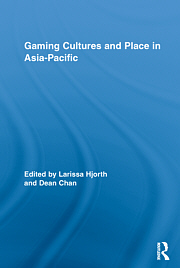
New book out: Gaming Cultures and Place in Asia-Pacific

Just got my copy of a new book from Routledge, "Gaming Cultures and Place in Asia-Pacific" edited by Larissa Hjorth and Dean Chan. Dal Yong Jin and I wrote the first chapter in Part I titled, "The Politics of Online Gaming," where we explored the geo-political, economic, cultural and social dimensions of Korea's creative industries in the form of online gaming.

You will also find contributions from...
Sam Hinton, Peichi Chung, Benjamin Wai-Ming Ng, Jun-Sok Huhh, Melanie Swalwell, Dean Chan, David Surman, Christian McCrea, Theodor G. Wyeld / Brett Leavy / Patrick Crogan, Ingrid Richardson, Holin Lin / Chuen-Tsai Sun, Larissa Hjorth / Bora Na / Jun-Sok Huhh

Description of the book:
This collection explores the relationship between digital gaming and its cultural context by focusing on the burgeoning Asia-Pacific region. Encompassing key locations for global gaming production and consumption such as Japan, China, and South Korea, as well as increasingly significant sites including Australia and Singapore, the region provides a wealth of divergent examples of the role of gaming as a socio-cultural phenomenon. Drawing from micro ethnographic studies of specific games and gaming locales to macro political economy analyses of techno-nationalisms and trans-cultural flows, this collection provides an interdisciplinary model for thinking through the politics of gaming production, representation, and consumption in the region.

Anyone interested in the latest research on gaming culture, particularly in the Asia-Pacific should take a gander through these pages.

You can get your own hardcopy of the book from Routledge here>>
Or, you can get a Kindle edition from Amazon here>>
Or, the library, like SFU here>>

Labels: , , , , , , ,

Tuesday, March 24, 2009

"I thought you'd blog more in the field..."

Was what one of my friends quipped to me over lunch last week. This was regarding the level of blogging whilst doing my dissertation fieldwork in Korea. Believe you me, I was at times somewhat disconcerted that I wasn't revealing something interesting every day, or that I wasn't one of those journalistic sites for the 'latest and greatest from Korea' as it were.

Then I thought to myself, well that's not what I have been using this blog for, even before I left for the field. These issues have been bandied about by those in my circle but I will rehash them here: that the blog has transformed for its -purpose- in one's media ecology in light of recent innovations such as Facebook, Twitter, etc. The latter two I use more for stream-of-consciousness type-things... and those of you who followed me while I was actually there know that. Both require membership/authorization to some degree, while the blog is a very public site. This is going to change the dynamics of my use, and it did. So, that was the medium question.

As for other reasons, as anthropologists commonly talk about, "anthropologists were notoriously private when it came to talking about their field experience." Here is a great post, complete with lots of yummy links attesting to that from Rex at Savage Minds. I would add my own story to the entry, in that when you're in the field:
  • There is simply too much going on in your head, the field, others, etc to really blog anything of worth. Certainly not every day. After all, is what you're observing in the culture really what you make of it? Enough to be confident in your re-presentation (that same day)? Probably not.
  • The field is an emotional roller coaster. You are not at -home-, nor are you anywhere you can really escape so whatever is blogged would likely be pretty ugly or something you regret later. Honestly, there are moments of levity, and there are some dark, dark times. Ask anyone who has done this type of physically/intellectually/emotionally (not to mention financially!) invested ethnographic fieldwork. Things not fit for public consumption on a blog on the fly, imho. Perhaps twitter/fb where one is relatively sure of who may be reading it and relatively confident about context.
  • Confidentiality concerns. There tends to be so much one does off the record that it takes time to form coherent narratives that do not violate the trust of one's informants. That is (and was) a high priority for me. So yes, the gems are being excavated... and they must be analyzed and polished to be anything one is proud of.
Anyboos, my surface parcel of worldly possessions just arrived for me in the mail from Korea. 4 weeks from Seoul to Vancouver. Not bad eh?

Labels: , , , , , ,

Monday, January 12, 2009

The battle for sunlight, sleep, and happiness.

Some interesting Korean news articles in the last few days:

The battle for sunlight>>
The battle for sleep>>
The battle for happiness>>

... and a resolution to get more of all these little big things that should not be taken for granted. They are all too easily deferred.

Labels: , , ,

Wednesday, January 07, 2009

The 2008 KOGIA Plays of the Year

KOGIA, which is the Korean Games Industry Association (founded by the Ministry of Culture and Tourism in 1999 for the purpose of developing the game industry as the key future strategic industry of the country) has announced the winners of its first Global Online Game Awards for 2008.

It probably comes as no surprise that Blizzard Entertainment's World of Warcraft was voted as the world's best role-playing game, and that Nexon's Kartrider handily got the nod for best racing/casual game.

"Other award winning online games include Valve's Counterstrike Source for best first-person shooting game, NCsoft's City of Heroes/Villains for best adventure/action game, EA Sports' FIFA 09 for best top sports game, and CCP Games' Eve Online for best strategic simulation game."

Read the story from Gamasutra here>>


While I'm on the topic of movers and shakers in the games industry, a reminder that the LOGIN 2009 conference (Seattle, May 11-14) call for speaker submissions goes on for another two weeks.

The Call for Speakers is open to all online game industry experts worldwide, whether for console, PC or mobile platforms. Candidates are asked to review the topics of interest and session submission tips on the LOGIN 2009 website and then submit a completed session proposal form and speaker application.

Details here>>

By the way, I'm still in the midst of conducting interviews with those involved in the Korean Games Industry, so if you're based here in Korea, or making a trip here within the next two months send me a note. It's the home stretch now!

Labels: , , , , , , , , , , , , ,

Wednesday, December 24, 2008

Season's Greetings from Constructing Amusement

Dear All, wherever you are in the world--
Here's wishing you and yours a very joyous holiday season, filled with love and laughter.

It's been a challenging, utterly immersive, mind-bending year here at Constructing Amusement: Korea edition. Very productive, and a little too much so at times with little reprieve! The holidays however, provide the proper opportunity to take a step back for everyone and reflect on the past year and look forward to the year to come. Such opportunities, even if not readily apparent, must be sought out and seized.

A little over 2 months in the fieldwork left to go. Many new and old friends who smooth out the process in Korea. To friends in Canada (and the RoW), I look forward to catching up with you soon. Not too much longer--please bear with me.

I leave something with you that seems to capture the spirit for me. Telling of the culture I grew up in. ;) Have fun.


Best,
Florence

Labels: , , , , , ,

Friday, December 05, 2008

Google Maps in Korea and navigating the sprawl

Last week, an interviewee told me that Google Maps had -just- recently launched in Korea.

I think it was September, when I was looking at Google maps trying to find Korean places to no avail. There was China, and Japan... and BLANK in the middle where Korea was supposed to be.
This will be interesting, given that navigation here, as others have pointed out (nice ref to U2 btw;), is done by landmarks like subway stations, shops, and services. This leaves people like me, who like to navigate by street names somewhat distraught.

I have adapted to this and since I ride the subway more often than not, find the maps on websites ok for finding places. Some interesting and sadly typical experiences one should keep in mind when navigating here:

1. If at all possible, try to find it yourself. Asking locals is hit and miss. My local friends have told me that even when they don't know a place, they will point someone in any direction just to 'help.' More than once though, I have been personally escorted by a local to the place I was looking for because it was easier than being told. This is not always a language barrier issue, and many locals do the exact same thing with their mobile phones: call when you get to (x) point, I will come and escort you down a little alley, into a basement, where the (y) is. Seriously. Implications for technology? Tonnes.

2. I have had taxi drivers in the local neighbourhood punch in exact addresses into their GPS and come up with nothing. Then I have had to leave the cab with a shrug.

3. Due to the social, historical, and economic clustering of Seoul, people are not inclined to leave their immediate neighbourhoods. Anyone who's lived here for a while knows about the groaning that takes place when one has to go "North" or "South" of the river, just say.

Sites like Naver is kind of like an Ask Jeeves (back in the day), sponsored crowd-sourcing type site. For a good comparison, see James Larson's blog>> and that is generally what Koreans like to use if not relying on local trusted knowledge.

Korea Times article on Google Maps debut >>

Labels: , , , , ,

Tuesday, December 02, 2008

Games not addictive? Sound familiar?

Well, some heartening news. Thanks to Aleks K. at the Guardian Games blog for posting this one:

"Games not addictive says game addiction clinic founder."

So the Netherlands front looks like it's turning out well. I'm still fightin' the good fight here on the Korean front.

Labels: , , ,

Monday, November 10, 2008

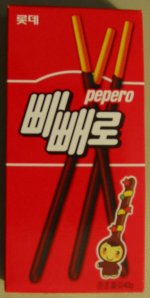
Pepero Day - 11/11

Today is Pepero Day, and if you didn't know it before, in Korea you'll notice the Pepero gift packs for sale in the weeks preceding today. Very different from what 11/11 means in the West (Remembrance Day).

In the past, I have seen people exchanging boxes of Pepero, and bakeries selling full-length baguettes dipped in chocolate (because they look like huge Peperos, of course). Yep.

It's a little scary how well the marketing worked on this one, though not surprising in considering the terrain.

**UPDATE: Some shots today of Korean pop icon Rain being, quoth POPSEOUL, "generous with his magic sticks." And, -only- if you're the immature (tsk tsk) type who laughed at that will you find the running Rain joke funny at all...uhuh.
Studying popular culture has its hazards.

Labels: , , , , ,

Thursday, November 06, 2008

Cyworld tanks in the USA

So, Cyworld has not made it in America. Story in Korean from hankyung.com here>>

In one of Web 2.0 Asia's latest posts titled, "Cyworld pulling plugs from the US," Chang muses about the cause of Korea's #1 social networking site failing in the localization effort for the United States market.

What can I say, except that (in the style of Stephen Colbert)...

I CALLED IT.

Labels: , , , , , , , ,

Monday, November 03, 2008

A deeper look at OECD numbers

From Mark Goldberg's blog, a deeper look into the OECD numbers on broadband penetration in which he talks about South Korea's situation on what counts towards rankings.

From his entry:

One would think that homes with computers would be the asymptote for broadband penetration - why would a household subscribe to broadband if you don't have access to a computer?

Well, apparently in Korea it doesn't work that way. In fact, 20% of their broadband enabled households have no access to computers.

What is going on there?

When you dig deeper, it turns out that Korea's household broadband data includes broadband enabled mobile phones. Since virtually every phone in Korea is a 3G phone, every household with a mobile phone is scored as having broadband access.

Sometimes, you need to scratch beneath the surface.

He states in the comments that apples are indeed being compared to apples in his analysis and asserts that raw rankings and numbers are irrelevant without analysis and context.

Raw rankings and numbers are manipulable, and it is tough to get one's hands dirty to actually find out what is happening on the ground. That's why I'm here.

Labels: , ,

Wednesday, October 01, 2008

Bruce Sterling's Lift Asia talk on video

From Laurent Haug's Lift blog, the talk by Bruce Sterling (on mobiles and the urban poor) at Lift Asia which I talked about here is the first video available on the Lift website.

As Laurent mentioned, "His talk - and especially the part where he advices South Koreans to prepare for an influx of poverty once the Northern regime collapses - has moved a large part of the audience, leaving a strange silence in the room as we came out for the break."


Labels: , , , , ,

Friday, September 12, 2008

It's Chuseok weekend....

It's the beginning of Chuseok weekend here in Korea...
My plans to go to Pusan fell through (gotta love the unpredictability of fieldwork!), so I'm staying in Seoul after all. Because much of the population will be attempting to get out of the city to their home villages (I've experienced this before, and traffic is uuuugly...) it will be an interesting experience to see what the city is like in a rare and relatively 'quiet' time.
There are actually quite a few 'cultural events' taking place in Seoul. Check out this expat-oriented website for a list of activities for Chuseok>>

Like holidays anywhere, people get pretty stressed out about Chuseok because there's a lot of lead up in terms of preparation and organization. But I'm pretty sure from first-hand experience that the proportion of stress for this holiday is considerably more than 'enjoyment'... as the rituals associated with Chuseok are all about the ancestors and thanking them for the 'good harvest' generally coinciding with the 15th day of the 8th month in the Lunar calendar. After Chuseok, people seem to relax much more around here and meetings/interviews (just say) are much easier to schedule.

The next ancestor-oriented holiday in Korea that I'll be able to observe is Seollal (Lunar New Year). That time is very important as well, and a little more cheerful... I mean, you'd say Happy New Year... but saying Happy Chuseok is something I only hear expats say ;)

So, I'm off to brunch and then I'll probably take in some of these events to -learn myself- some culture.

Labels: , , ,

Tuesday, August 19, 2008

Official announcement of competition results

At last, I am pleased to announce that I am the grantee of a Korean Government Scholarship offered by the National Institute for International Education (NIIED) through the Foreign Government Awards program, jointly administered by the Canadian Bureau for International Education (CBIE), on behalf of Foreign Affairs and International Trade Canada (DFAIT).

The KG Scholarship, along with a Graduate International Scholarship from the SFU Dean of Graduate Studies will directly support my dissertation field research in Korea for the duration of 6-months.

I'm headed there at the end of this week, with my truckload of official documents in hand. Stay tuned for the ride that will commence shortly!

Labels: , , , , , , , ,

Wednesday, August 06, 2008

Almost there: Pre-fieldwork particulars

It's been a hectic little while...

In less than 3 weeks, I'll be heading to South Korea for 6 months of ethnographic fieldwork on the intergenerational use of information communication technologies (games, wireless, etc), and the changing social dynamics in the nation amidst the impacts of transnationality.

The Department of Communication at Seoul National University has invited me to commence a stay with them as a Visiting Researcher during that time. I'll be working with Professor Myungkoo Kang, who is a leading authority on the concept of East Asian Modernity and the study of media and culture.

In addition to the scholastic rigours that come with such an endeavour, I've also been distracted (to put it mildly) with the bureaucratic rigours as well. More than usual. It wouldn't be a blog entry without some inanity, so the laundry list of the last 3 weeks includes:

  • Phone calls with governmental organizations, with paperwork follow-up
  • Health exams: chest x-rays, vaccinations, blood, (and yes everything else!). I'm in "excellent" health, by the way--the paper says so now.
  • Administration: ordering documentation, booking flights, accomodation, registration, scanning, emailing... unsubscribing to this, subscribing to that, it's all stuff that needs to be done.
  • Purchasing research materials--books, equipment, favourite face cream. (ok, that's not research... or is it...:)

The problem, as many know... is that many of these things rely upon the schedule of others. So if there's not enough time to crank the wheels, there's simply nothing one can do. Wait in the cue. Have a good book. Get really practiced at saying, "it's alright" to people at the counter just doing their jobs.

Fieldwork is a full-bodied effort. It's the virtue and vice of being an ethnographer. You have to be 'there,' and take everything that comes with getting there, being there, and leaving there. In addition to that, there's the administration that comes with being here, leaving here, and coming back here..... nevermind securing the funding and support to carry those plans out.

So, I've been yammering about this trip for four years since my last fieldwork stint in Korea four years ago, applying for this and that grant, asking for reference letters, signatures, coffee talk, sanity checks. The time has finally come, and I bet everyone else is relieved along with me. Fortunately, I've encountered very helpful, kind, and positive people who are on my side when it comes to getting these things done (in all stages of the aforementioned tasks). There has also been some great news regarding getting this research funded, for which I'm just waiting on the official announcement of before letting the cat out of the bag here.

Labels: , , , ,

Saturday, June 21, 2008

On being "Korean Enough"

Through his blog "Koreanish," writer Alexander Chee links to an essay published in Guernica titled, "Korean Enough: Alexander Chee on New Korean American Fiction." I highly recommend it, for anyone interested in the complexity of ethnic identity as it spans geography, generations, and even measures of authenticity.

I was interested in the article from the start, but by the second paragraph the article was thoroughly resonating with what I have found in my own experience and seek to convey as time (and my research) goes on:

My father’s family in Korea keeps traditions they brought with them from China in the 15th Century that the Chinese no longer keep; they use an archaic Chinese script in the keeping of our family’s records. They perform, inside the confines of my family, these rituals of this lost homeland—even as they tell me they fear I’m “not Korean enough,” with no sense of irony whatsoever.

Even this short paragraph is so packed with nuance: a) Korea's proximity to a dominant and large nation (China); b) How narratives are transmitted in a literate and oral context; c) The performance of ritual as a way to ensure continuity and affirmation of an all-too-fragile sense of identity; and d) The tenuousness of authenticity and representation.

I have to say that it hit me on a personal level of course--anyone who's ever been singled out as visibly different in their primary context of operation may relate to the feeling of being an 'alien' or of feeling "yes I belong" and at the very same time "how could I ever really belong."

As an ethnographer, or, "Professional Stranger," (as Michael Agar has written), the feeling of being an Angel, Ghost (as Grant McCracken has talked about), or Alien in the context one is studying--is part and parcel with the ability to see things as if one doesn't belong. And yet, we have the need to function (or sometimes not) within that context. When it's your job, culture shock is not shock anymore per se, but rather a constant state of orange/red alert that is physically and emotionally taxing and also par for the course.

In her address to the class of 2008 at the Berkeley School of Information last month, Genevieve Bell from Intel recounts her emotional experience with a Korean shaman and tells those in the audience that if one is not in tears at least once in the field in that manner, then one is not really embracing the experience.

Me thinks to self: Yep.

In my fieldwork experiences, my authenticity has been tested implicitly and explicitly many a time. We do this in many ways. Even as gamers, there is the said and unsaid about whether or not someone is "hardcore" enough--and almost a destructive culture of intensity where one's authenticity and social status hangs in the balance. Pain of (virtual?) death should one not prove worthy. I've written about this as it pertained to a particular raid in World of Warcraft.

Culture is shared knowledge in a system of meaning. In the Korean context, I was often told, "Once you know x, you will be truly Korean." x, at times equated with the ability to eat spicy food, knowing when to pay for the bill, knowing Seoul's expansive subway system, or how/why Tim Horton's to Canadian national identity can't hold a candle to the affinity Koreans feel for Kimchi and it's pervasive role in society, life, and death.

Alexander Chee's article was an excellent piece--driving home just how very much a state of mind authenticity is, and just how true (and necessary) the myths and fictions we create for ourselves often are. Have a read.

Labels: , , , , , ,

Wednesday, March 19, 2008

First gaming event to go intercontinental - Seoul

From the JoongAng Daily:

The Seoul Metropolitan Government wants to position itself as a hub of e-sports by co-hosting the 2008 Seoul International e-Stars gaming competition in July. The city of Seoul plans to launch a second fund to promote the e-sports industry, following the previous 30 billion won [$30.9 million] fund initiated for cultural events.

Read the rest of the article>>

Labels: , ,

Monday, January 28, 2008

The console/online game divide and changing business models

From Gamasutra, a focus on the console/online game divide in Korea with commentary from Stephen Lee of Nexon (MapleStory) with reference to interviews done during Korea's G-Star games show.

Related to that is an announcement from EA that it plans to make a major departure from its traditional business model (box sales) and distribute an installment of its hit Battlefield series as a free download on the Internet.

Rather than being sold at retail, the game is meant to generate revenue through advertising and small in-game transactions that allow players to spend a few dollars on new outfits, weapons and other virtual gear.

At a conference in Munich, the company intends to announce that the new game, Battlefield Heroes, will be released for PC this summer. More broadly, E.A. hopes the game can help point the way for Western game publishers looking to diversify beyond appealing to hard-core players with games that can cost $60 or more.

E.A.’s most recent experiment with free online games began two years ago in South Korea, the world’s most fervent gaming culture. In 2006, the company introduced a free version of its FIFA soccer game there, and Gerhard Florin, E.A.’s executive vice president for publishing in the Americas and Europe, said it has signed up more than five million Korean users and generates more than $1 million in monthly in-game sales.

NYT story here>>

Because gaming is indeed a global industry, it is really interesting to see how business models are changing to actually reflect the dynamics of local user cultures. This is illustrated by plans to obtain revenues by bringing micropayments (e.g. buying shoes for one's avatar) to Western players along with other such strategies (that cope with piracy issues) that have been used in Korea for quite some time. Instead of fighting the tide by clamping down on piracy in the name of antiquated business models, there is room to be creative and find new and innovative ways to remain competitive in the industry.

Labels: , , , , , , , ,

Monday, January 14, 2008

EA establishes development base in Korea

On Thursday, Electronic Arts announced that it plans to set up a development studio in Korea within the year and create three or four new online games.

Famous for hit series such as "FIFA Soccer" and "The Sims", the company's sales stand at US$3.7 billion.

The Chosunilbo reports:

EA aims to secure talented Korean game developers to lay the foundation for a future advance into the Asian market. Senior producer Danny Isaac will head the new studio.

"The size of the studio hasn't been decided yet," a company source said. "First we plan to recruit dozens of workers to develop the 'NBA Street' and 'Battle Field' online games, but if we have more applicants than expected we may increase the size of the studio and develop another game.”

The company estimated that it will invest at least W20 billion (US$1=W938) in the studio.

Labels: , , , , ,